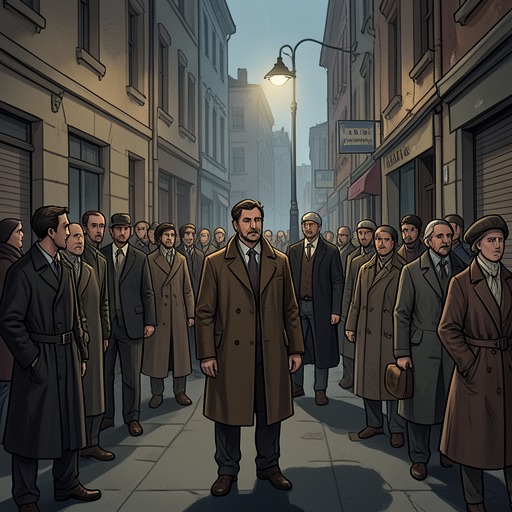
Aeron’s heroic ballad
The Ballad of the Last DragonAeron’s heroic ballad is the central instrument of the company’s campaign to preserve Aeron Fowler’s honor after his death. It is not merely a song about past adventures: it is a continuing performance, a public identity, and a carefully managed fiction through which Sylvaine Abelan tries to bring Aeron home as the hero he wished to be. Its decisive significance lies in the way it converts absence into presence. Aeron cannot return to the taverns or slay the dragon in life, but his name can travel ahead of the company, gather force, and eventually compel the restoration of his reputation.
Purpose and Construction
Sylvaine’s plan is openly strategic. She proposes that the company carry on as though Aeron still lives, while she writes and sings ballads in his name, exaggerates his stature, spreads reports of his exploits from inn to inn, and completes further contracts under his identity. The company can explain his physical absence from any particular tavern, while the repeated circulation of his name makes him increasingly difficult to dishonor. The ballad therefore operates simultaneously as memorial, propaganda, and cover story. Its planned culmination is that Aeron will die bravely while taking the dragon down with him, giving the public a heroic ending capable of replacing the humiliating truth of his death.
The construction of the ballad depends on performance as much as composition. Sylvaine prepares speeches, preludes, prompts, and successive sections rather than presenting a fixed song in isolation. Before unveiling new material, she waits until the crowd has accepted her as its principal entertainer, listening closely and responding at the expected moments. Only then does she begin the next part of Aeron’s story. This staged progression lets her control both the audience’s emotions and the conditions under which Aeron’s reputation is formed.
Episodes and Expanding Legend
The first major section recounts Aeron’s victory over the monstrous beetles. In Sylvaine’s telling, he vanquishes the creatures and, with help from his loyal crew, destroys the entire nest. The performance is physically demanding: her forehead sweats into her eyes, her fingers ache from new calluses, and her neck burns. Those bodily costs matter because the ballad is not an abstract memorial; Sylvaine must repeatedly spend her own strength to make Aeron’s courage audible to strangers.
She later adds the arachnida fight to the song, emphasizing Aeron’s dauntless attack against beasts while armed with nothing more than river rocks and a refusal to accept defeat. The episode demonstrates how the ballad grows through revision. New adventures are absorbed into an accumulating heroic pattern, and each retelling makes Aeron seem more consistently fearless. Sylvaine recognizes the contrast between the public version and her private perception: when she imagines herself in the same story, she sees fear and weakness, whereas Aeron’s role is shaped by courage. The ballad thus elevates him not only through events but through selective framing.
The company also uses the ballad to recruit informal allies in the work of transmission. Neith cultivates dwarven merchants traveling the main roads to Bridgebarrow, making friends with people likely to spread news of the company’s exploits. The song’s reach consequently extends beyond the room in which it is performed. Each tavern becomes one link in a chain of hearsay, performance, and commercial opportunity, allowing Aeron’s reputation to move along the same roads as the adventurers.
Performance and Disguise
The ballad’s public life reaches a crucial stage when Cadoc is to don Aeron’s armor. Sylvaine takes the stage for an encore that no one has requested, creating the acoustic and dramatic space for Aeron’s supposed grand entrance. She presents herself as ready to put on a show, fastens a bright smile over the strain of the plan, and accepts her lute from Jaromir while his fingers linger on hers. The scene makes clear that the deception is a collective performance: Sylvaine supplies the voice and narrative, Cadoc supplies the visible body, and Jaromir helps sustain the emotional and practical machinery around them.
The armor itself is an imperfect prop, and its limitations expose the comic labor beneath the legend. At the Golden Selkie in Greenfell, Jaromir appears in Aeron’s armor, though only the chest plate fits; the greaves are too short, and watching him attempt to walk in armor that does not fit provokes laughter from everyone except Jaromir. Yet the mismatch does not wholly weaken the image. Sylvaine still sees Jaromir’s hardened leather cuirass, powerful arms, loose dark hair, and perpetual scowl as a dangerous, almost wild presence. The disguise works through the audience’s willingness to accept a recognizable emblem rather than through physical perfection.
Sylvaine also calibrates the language of the performance to the people hearing it. At the Golden Selkie, she learns that references to the goddess or her guardians alienate the audience, so she adjusts her speech accordingly. Her proclamation celebrates Aeron as the greatest hero of the age, magnifies his divine ancestry, praises his unmatched virility, and enlarges his generosity. The inflated rhetoric is intentional: the ballad is shaped not only by what happened but by what a particular crowd is prepared to admire. Its adaptability is one of the reasons it can carry Aeron’s name across different towns.
Grief, Collaboration, and Consequence
Although the ballad is designed to manipulate public belief, it remains rooted in grief. Sylvaine expects anger when she explains the plan, and her cheeks burn as she insists that the performance does not sully Aeron’s memory but honors his wishes. The language of welcoming him home gives the campaign its emotional center. The company is not simply manufacturing a profitable hero; it is trying to provide Aeron with the homecoming and heroic welcome that death denied him.
The other performers become part of that act of remembrance in distinct ways. Jaromir suggests the embarrassing prelude that Sylvaine uses before the main material, accepting his own discomfort if it might earn Aeron goodwill. He winces during the introductory ballad, but remains involved in the performance and later wears the armor. Neith applauds and helps cultivate audiences, while Cadoc’s participation turns the absent man into a visible figure. Sylvaine’s own pleasure in playing and slipping into the role of storyteller coexists with the pain of the work; she seeks out Jaromir in the audience and draws strength from his warm response. The ballad therefore binds the company together through coordinated repetition, even as it keeps Aeron’s absence at the center of every gathering.
Its consequences extend beyond remembrance. The company’s repeated tavern appearances spread news of Aeron’s supposed exploits, create opportunities to acquire contracts in his name, and build enough momentum that his brother may eventually be forced to restore his honor. The ballad makes reputation a material force: a story repeated across roads and drinking houses can pressure family authority, redirect public judgment, and determine how a dead adventurer is received by the world.
Narrative and Thematic Significance
Aeron’s heroic ballad reverses the ordinary structure of heroic return. The hero is dead before the quest is complete, while his companions perform the return on his behalf. His resurrection is therefore symbolic and social rather than physical. The ballad supplies the missing final movement of his legend by arranging a future death against the dragon, allowing Aeron to appear to complete the heroic journey even though the living must carry him through its last stage.
The ballad also makes storytelling an ethical action rather than a decorative art. Sylvaine does exaggerate Aeron “beyond measure,” and the performances contain obvious comic and commercial calculation, but the exaggeration answers a real injustice: Aeron’s memory risks being diminished unless someone gives it a form the public can recognize. Through repeated retelling, private knowledge becomes shared history. The song’s deepest claim is that a life does not end at the point where the body disappears; it can continue through the voices willing to bear it from one audience to the next.